Christos Vandis
Cartes Postales from GreeceChristos Vandis is a wealthy shipowner from Andros whose marriage to Antigoni is founded on convenience rather than romance. Seeking a dependable wife to manage his household during his long absences at sea, he brings her into a life of isolation and control. His return after more than a year makes that arrangement’s cost unmistakable: he responds to Antigoni’s paintings not with recognition of her work, but with anger, destroying the pictures and driving her from the house.
Identity and choice of a bride
At forty-five, Christos has inherited his parents’ property after their deaths and expects to return to sea soon. He is not seeking a wealthy wife; he wants someone he believes he can trust to run his household while he is away. In Piraeus he has noticed Antigoni, with her fashionable short dark hair and pronounced nose, on more than one occasion. Discreet enquiries establish that her father manages a port, which is sufficient for his purposes.
His choice reflects a deliberate preference for reliability over glamour. Christos does not want a flighty, exceptionally beautiful bride whom he cannot trust in his absence. Antigoni’s sister Ismini, by contrast, is conspicuously pretty and attracts male attention. Antigoni is nearly thirty when her father accepts Christos’s proposal on her behalf; she agrees partly because she sees herself as an obstacle to Ismini’s wish to leave home and marry. The match thus begins within a family custom that places the elder sister’s marriage before the younger’s, and with Antigoni making a sacrifice for Ismini rather than pursuing a passionate attachment of her own.
Marriage and prolonged absence
After the wedding, Christos instructs Antigoni about which of the island’s eccentrics and mavericks she should avoid. His advice may be intended to keep her safe, but she senses a more restrictive purpose: he seems to want her kept at home, as if put away until his return. The husband’s protection and his control are difficult to separate; in either case, Antigoni’s world is being narrowed to the household.
In late July, only three and a half weeks after the wedding, Christos leaves for North America. He expects to be away for a year, even if the sailing conditions are good. Antigoni is left far from home, feeling abandoned and exiled. In the weeks that follow, the brief attraction that had grown between them fades. His presence survives chiefly through the scent of tobacco and cologne on his suits, which she seeks in his dressing room, or recognizes near a café where men are smoking. Even this sensory reminder eventually dissipates.
The rhythms of Antigoni’s days underline how little companionship the marriage provides. She visits, or receives visits from, other shipping wives, rarely speaking to anyone else; her exchanges with the maids mostly concern what she wants to eat. During the hot summer she is lethargic, and the heat slows the days into sleepless nights. Christos is absent, but his household remains the setting of a life organized around waiting for him.
Return and destruction of the paintings
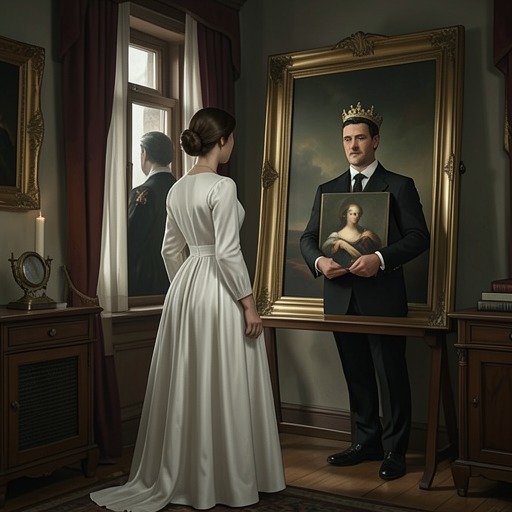
More than a year after Christos’s departure, a cable announces that his boat will return in a week. Antigoni is pleased at the prospect of seeing him, yet wonders how much of a stranger he will be. She stands beneath his portrait in the hallway to reacquaint herself with his face; the scent that had once helped her imagine his presence is gone.
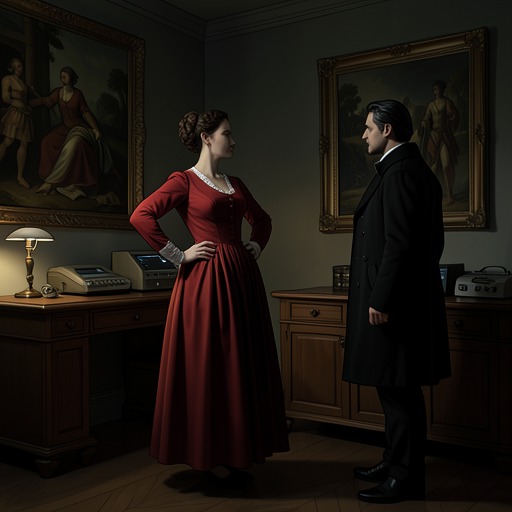
When he comes home, their formality confirms the distance between them. They had barely known each other before he left, and now must become acquainted again. The dining room, which had served as Antigoni’s painting space, has been returned to its original use. She has put away her easels, brushes, and paints, and a maid has removed some splashes from the floor. But the room’s changed appearance cannot conceal what she has made: instead of the family portraits, Christos sees vivid paintings of the wet witch, a maverick priest, a couple, and a rugged fisherman. Their defiant gazes seem to meet his, but he does not recognize the accomplishment in them. His first concern is the missing family pictures.
His anger escalates from a demand that the paintings be taken down to an order shouted at Antigoni. He then takes her into the paved yard, where her four portraits and leather portfolio have been piled on kindling. Fire is already catching beneath them. When she reaches to save the work, Christos grabs her arm and commands her to obey and show respect. The destruction is not an abstract rejection: the portfolio melts, the pictures curl and lift into the fire, and Antigoni sees Ismini’s image among them. At that sight she pulls free and runs through the house and out the front door.
Conflict and narrative significance
Christos’s arc is defined by the contrast between his stated practical requirements and the human consequences of the life he imposes. He wants a trustworthy wife to maintain his household, yet his long absence leaves Antigoni lonely and estranged from him. When she fills the dining room with her own work, the paintings make visible a life and vision that have developed outside his direction. His demand to restore the family portraits, followed by the burning of her art, turns domestic authority into open force.
The episode also sharpens the difference between being treated as a suitable wife and being recognized as a person with creative agency. Christos has selected Antigoni for the qualities that suit his household and has attempted to regulate whom she sees; on his return, he cannot accept the paintings that have occupied the space while he was away. His intervention destroys both the work and the fragile domestic arrangement that the marriage depended on. Antigoni’s flight, triggered by the burning image of her sister, marks the decisive break in the evidence presented: she leaves the house rather than submit to the order Christos has asserted.